What an AI reads before it recommends you
What search engines and AI assistants can read on a small-business site, what is documented and what is guesswork, and the four things every site we build has.
A customer opens ChatGPT and types "who does bathroom renovations in Oakville?" Three names come back. If yours is not one of them, the conversation is over before you knew it started.
That is agent search: a person asks an assistant, the assistant answers with a short list, and the list is the whole market. It is different from Google in one important way. Nobody scrolls. There is no page two. You are either in the answer or you are not.
How the assistant decides
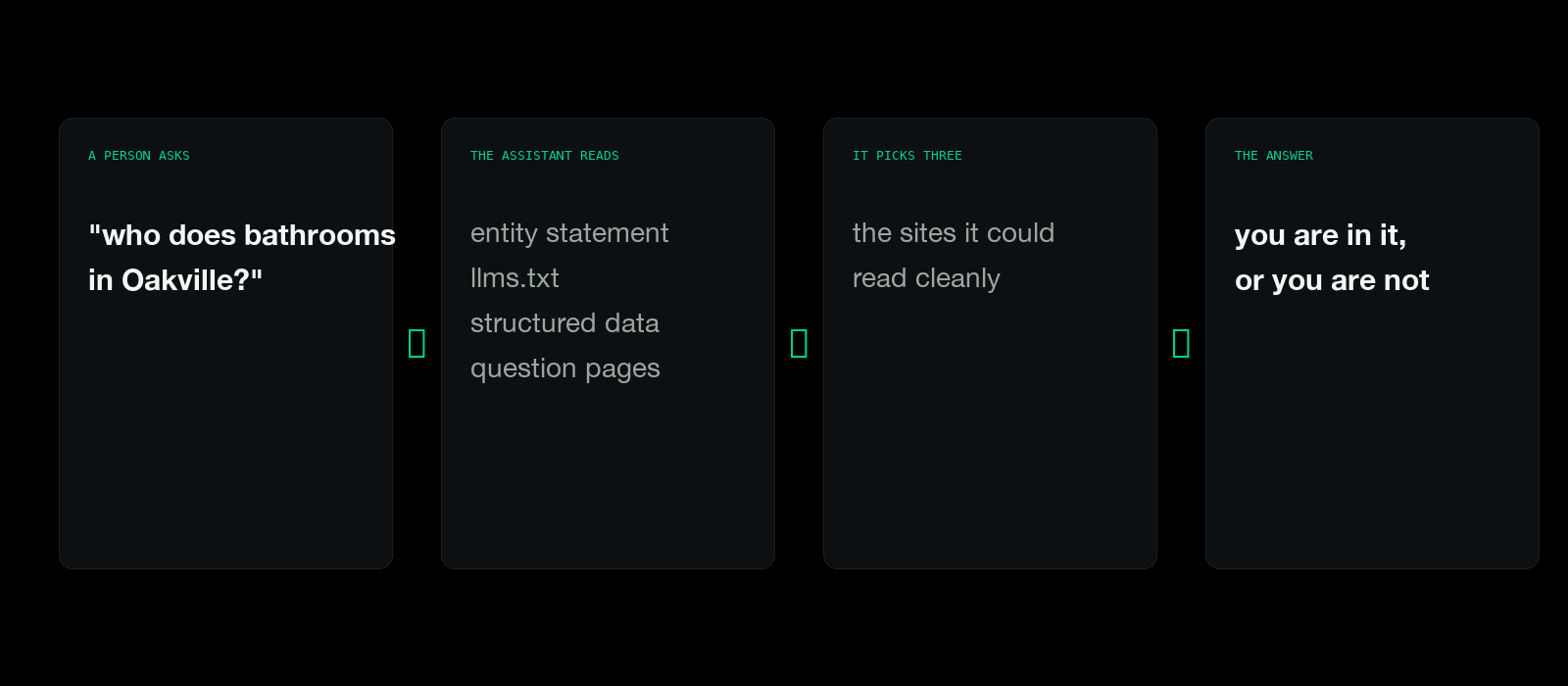
The assistant does not read your site the way a person does. It pulls a few pages, looks for signals it can trust, and moves on in a fraction of a second. Four signals do most of the work.
1. A plain statement of who you are
The first fifty words of your homepage should say what the business is, what it does and where. "Grizzly Construction is a general contractor in Burlington, Ontario. Kitchens, bathrooms, basements and commercial build-outs" is a sentence an assistant can use. "Building dreams since 2009" is not.
2. An llms.txt file
Search engines have used robots.txt for thirty years to learn what a site allows. llms.txt is a proposed companion file that says in plain text what the business is, what it offers, what it costs and how to reach it. It is an optional, emerging convention: Google says Search does not need it, and no major assistant documents reading it. It costs almost nothing, so we ship it, but as a tidy summary, not a way into AI answers.
3. Structured data
Under the visible page sits a machine-readable record in a format called schema.org: business type, services, prices, opening hours, the questions in the FAQ and their answers. It helps search engines understand the page; Google says no special markup is needed for its AI features.
4. Pages shaped like questions
People ask assistants specific things. "Basement apartment permits in Hamilton" is a question. If there is a page that answers it, plainly and in a few hundred words, that page gives a search engine something specific to show. If the only mention is a bullet on the homepage, it does not.
What this means for a small business
None of this is expensive. It is the kind of work that is skipped because nobody asked for it. Every site we build ships with all four signals, from the smallest tier up: the entity statement is written into the hero, llms.txt and the structured data are generated from the same content as the page so they cannot drift, and service and city pages are how the larger sites are organised.
The site you are reading does exactly this.
A test you can run today
Open ChatGPT, Perplexity and Google, and ask each one the question your best customer would ask. Do it for your city and your main service. Write down who gets named. That list is your real competition, and the gap between it and your current site is the work.
To see how easy your own site is for those assistants to read, run the free AI visibility check. It reads your site the way they do and lists what to fix, in order.
FAQ
How does ChatGPT decide which businesses to recommend?
None of the assistants publishes a formula for who gets named. An assistant pulls a few pages, looks for signals it can trust and moves on in a fraction of a second. On your own site, the signals you control are a plain statement of who you are, structured data that matches the page, and pages that answer specific questions.
How do I get my business recommended by ChatGPT?
Nobody can guarantee a mention. You can make your facts easy to read: say what the business is, what it does and where in the first fifty words of your homepage, add structured data that matches the page, and give specific customer questions their own pages. Then ask ChatGPT, Perplexity and Google the question your best customer would ask, for your city and your main service, and write down who gets named.
Does schema markup help with ChatGPT or Google AI Overviews?
Structured data is a machine-readable record under the page, in a format called schema.org: business type, services, prices, opening hours and FAQ answers. It helps search engines understand the page, but Google says no special markup is needed for its AI features. Every site we build generates it from the same content as the page, so the two cannot drift.
Does ChatGPT use my Google Business Profile?
None of the assistants publishes how it chooses. Whether an assistant names you depends on more than your website: your reviews, your Google Business Profile and what other sites say about you matter too. Keep the profile current, with the same details as your site.